Sports Bra Fitting Guide
Match your sports bra to every workout with confident measurements, impact charts, and try-on routines.
Measure for Movement
Accurate measurements help you pick the right support level before stepping onto the track, court, or mat.
- Measure your band snugly; sports bras rely on firm support around your ribcage.
- Measure the fullest part of your bust while standing tall to capture full movement range.
- If you use chest straps or heart rate monitors, consider their placement when measuring.
- Enter both measurements into the calculator using the same unit (cm or inches).
Match Support to Impact Level
Use the quick matrix and printable chart to map your training intensity to the control you need before you buy a new bra.
Activities: Yoga, walking, pilates, stretching
Recommendation: Use light compression or seamless bras that allow full range of motion.
Activities: Cycling, hiking, strength training
Recommendation: Opt for encapsulation or hybrid bras with adjustable bands and straps.
Activities: Running, HIIT, dance, court sports
Recommendation: Look for encapsulation + compression, molded cups, and wide straps for maximum control.
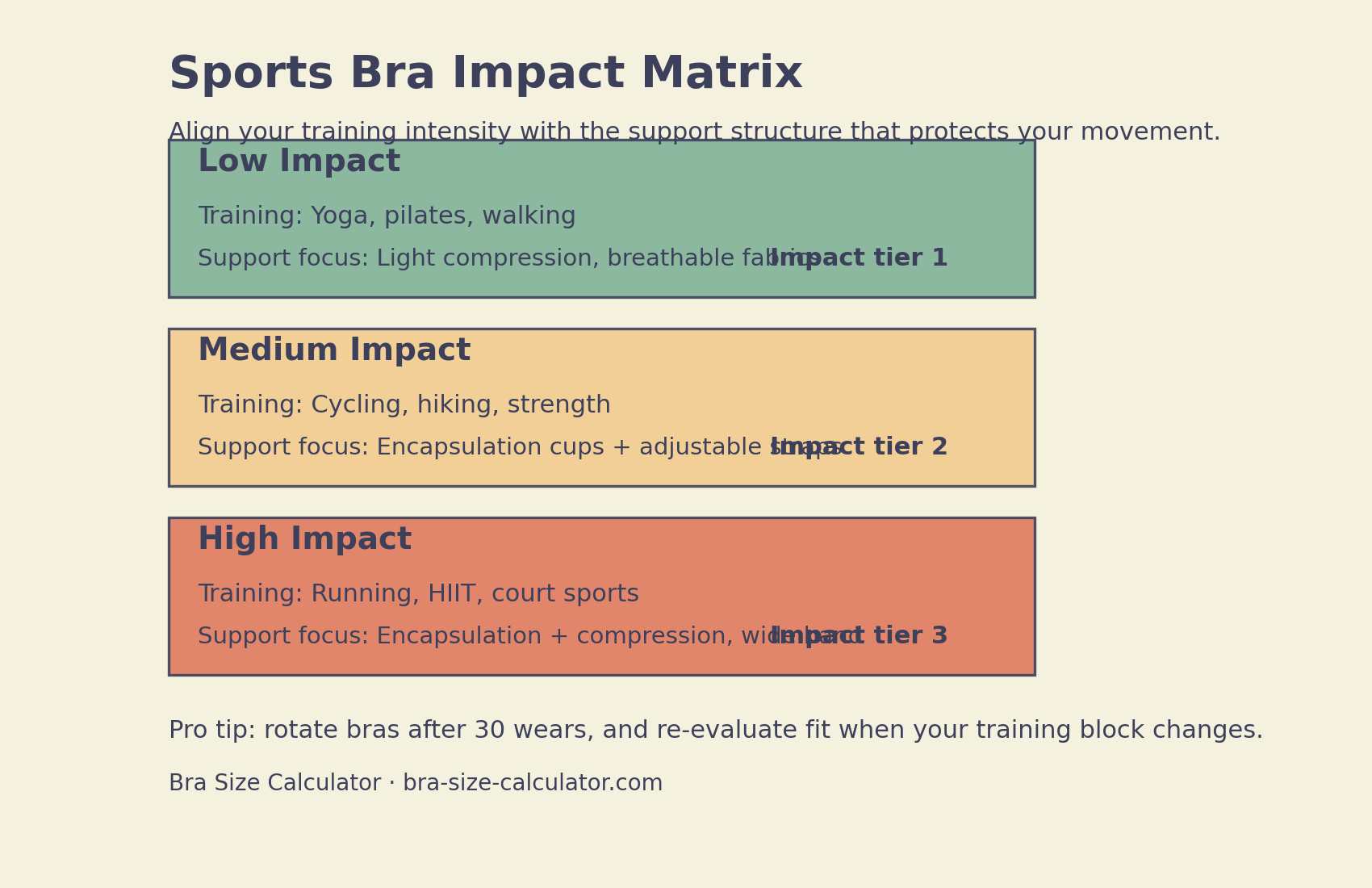
Download the impact companion chart
Print or save the chart to track which bras you rely on for low, medium, and high-impact days. Add notes for strap adjustments and rotation schedules so you know when to replace each style.
Get the impact chart (PNG)Know Your Sports Bra Styles
Hold the bust close to the chest; best for low to medium impact and smaller cup sizes.
Separate cups stabilize each breast; ideal for medium to high impact and fuller busts.
Blend encapsulation cups with outer compression for all-around control.
Hook-and-eye closures, convertible straps, and removable padding allow fine-tuning as training changes.
Test the Fit Before You Train
Use this routine in the fitting room or at home to ensure your bra is ready for movement.
- Jump, jog in place, and perform arm circles to test bounce control.
- Check straps after moving—two fingers should slide underneath without digging.
- Ensure the band stays level when bending or stretching. If it shifts, size down in the band.
- Look for gaping or cutting near the underarm; swap styles if needed to protect tissue.
Workout fit checklist
Print the workout fit checklist as a reminder before each training session. Consistent checks stop discomfort before it starts.
Download checklistComfort Habits for Athletes
Keep bras in top condition and your body comfortable through every workout.
- Rotate bras and hang dry to preserve elasticity and compression.
- Replace sports bras every 6–12 months or when support noticeably decreases.
- Consider moisture-wicking fabrics for high-sweat workouts to reduce friction.
- If you experience chest tightness, switch to a style with adjustable straps or front closure.
Helpful Resources
Support your training by keeping these guides handy.
Frequently Asked Questions
How often should I replace a sports bra?
With regular training, replace sports bras every 6–12 months or when band/support feels loose. High-impact athletes may need replacements sooner.
Can I wear the same bra for different workouts?
Yes, but match the support level to the activity. Use higher support for high-impact workouts and lighter styles for low-impact days to extend lifespan.
How do I prevent chafing?
Choose seamless or flat-seamed bras, keep fabrics dry with moisture-wicking materials, and adjust fit so the band and straps are snug but not restrictive.